Many applications do not need the strongest magnet on the market; they need a solution that is affordable, stable, corrosion-resistant, and easy to scale in production. That is exactly why the ferrite magnet continues to be one of the most widely used magnetic materials across industries. At SDM Magnetics, we often see customers shift their focus from maximum magnetic strength to overall project efficiency, where cost control, durability, and supply consistency play a more critical role in long-term success.
What makes ferrite magnets attractive in real products
Performance that matches everyday industrial needs
In practical engineering, most products are designed around a required level of performance rather than the highest possible performance. Ferrite magnets deliver stable and predictable magnetic output that meets the needs of a wide range of applications, including motors, speakers, and sensors.
This level of performance is often more than sufficient for products that operate under normal conditions. Instead of over-engineering with higher-cost materials, ferrite magnets allow manufacturers to meet specifications efficiently.
Why “good enough” can be the smartest choice
The idea of “good enough” is not about compromise but about optimization. Many successful product designs rely on selecting materials that balance cost and performance.
Ferrite magnets excel in this area because they provide consistent magnetic properties without unnecessary cost increases. For manufacturers producing high volumes, this translates directly into better pricing competitiveness and improved margins.
Why ferrite magnet remains a mainstream option
Despite the availability of high-performance rare earth magnets, ferrite magnets remain a mainstream choice because they address real-world needs. They are reliable, widely available, and suitable for continuous production.
For many industries, especially consumer electronics and appliances, this balance makes ferrite magnets a practical and dependable solution.
Why cost is one of the biggest advantages
Lower raw material cost
Ferrite magnets are made from iron oxide combined with strontium or barium compounds, which are abundant and cost-effective materials. Unlike rare earth magnets, they do not depend on limited or highly volatile resources.
This helps manufacturers maintain stable production costs over time, even in fluctuating global markets.
Better fit for high-volume production
Cost efficiency becomes increasingly important as production volume grows. Ferrite magnets are ideal for large-scale manufacturing because they offer predictable pricing and consistent availability.
This is especially important for industries such as household appliances and automotive components, where production runs can reach millions of units.
Why this matters for OEM and appliance projects
For OEM projects, even a small reduction in component cost can have a significant impact when multiplied across large quantities. Ferrite magnets provide an effective way to control costs without sacrificing essential performance.
This makes them a preferred choice for manufacturers aiming to deliver competitive products while maintaining quality standards.
Why ferrite magnets work well in humid and outdoor conditions
Natural corrosion resistance
One of the key advantages of ferrite magnets is their natural resistance to corrosion. Unlike some other magnetic materials, they do not require additional coatings to withstand humid or outdoor environments.
This makes them suitable for applications exposed to moisture, such as outdoor equipment or appliances used in high-humidity regions.
Why many ferrite magnets do not need coating
The absence of coating requirements simplifies production and reduces costs. It also eliminates potential issues related to coating wear or damage over time.
For manufacturers, this means fewer processing steps and lower long-term maintenance concerns.
What this means for maintenance and total cost
Reduced maintenance requirements translate into lower total cost of ownership. Products using ferrite magnets can operate reliably without frequent inspections or replacements due to corrosion-related issues.
This is particularly valuable for applications where maintenance access is limited or costly.
Why ferrite magnets hold up well against demagnetization
What high coercivity means in simple terms
Ferrite magnets have high coercivity, which means they are resistant to losing their magnetism when exposed to external magnetic fields or other influences.
This ensures that the magnet retains its performance over time, even in challenging environments.
Why stable magnetic performance matters in motors and sensors
In motors and sensors, consistent magnetic performance is critical for reliable operation. Variations in magnetic strength can lead to inefficiencies or performance issues.
Ferrite magnets provide stable output, making them suitable for applications where long-term reliability is essential.
Where reliable output matters more than peak strength
In many applications, consistent performance is more important than maximum strength. Ferrite magnets deliver reliable results without the need for frequent adjustments or replacements.
This makes them a dependable choice for industrial and consumer products alike.
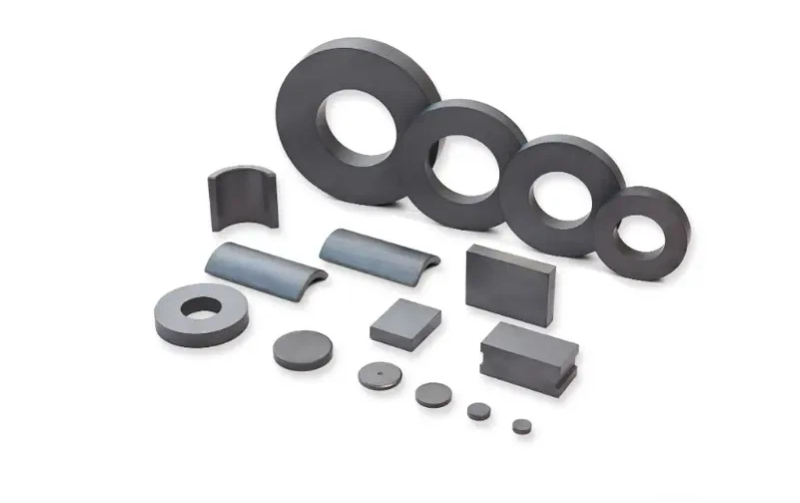
Why shape flexibility makes ferrite magnets practical
Standard shapes for common assemblies
Ferrite magnets are available in a variety of standard shapes, including rings, discs, and blocks. These shapes are widely used in motors, speakers, and sensors.
Standardization helps simplify design and reduces lead times.
Custom dimensions for product integration
In addition to standard options, ferrite magnets can be manufactured in custom dimensions to fit specific product requirements. This allows engineers to optimize designs for performance and space.
At SDM Magnetics, we support customized magnet solutions to meet diverse application needs.
How shape affects function and installation
The shape of a magnet directly influences its performance and how it integrates into a product. Proper selection of shape ensures efficient use of magnetic material and improves overall system performance.
This flexibility is one of the reasons ferrite magnets are widely used across different industries.
Which applications benefit most from ferrite magnet advantages
Speakers and audio devices
Ferrite magnets are commonly used in speakers due to their stable magnetic field and cost efficiency. They help maintain consistent sound quality while keeping production costs manageable.
Motors, pumps, and appliances
Electric motors in appliances such as washing machines and fans often use ferrite magnets. Their durability and resistance to environmental factors make them suitable for continuous operation.
Sensors, separators, and industrial assemblies
Ferrite magnets are also widely used in sensors and magnetic separators. Their ability to maintain performance under various conditions makes them reliable for industrial applications.
Why Buyers Choose Ferrite Magnets
Advantage | What It Means in Practice | Best-Fit Applications | Buyer Value |
Cost Efficiency | Lower material and production cost | Appliances, automotive | Reduced overall product cost |
Corrosion Resistance | No coating required | Outdoor equipment | Lower maintenance |
Magnetic Stability | Consistent performance over time | Motors, sensors | Reliable operation |
Shape Flexibility | Customizable geometries | Industrial assemblies | Easier integration |
Supply Stability | Widely available materials | Mass production | Stable supply chain |
What are the trade-offs buyers should know
Lower magnetic strength than neodymium
Ferrite magnets do not provide the same level of magnetic strength as neodymium magnets. This means larger sizes may be required to achieve similar performance.
Brittleness in handling and assembly
Ferrite magnets are brittle and can crack if subjected to impact. Proper handling and design considerations are necessary to prevent damage.
Why the right magnet is application-specific
Selecting the right magnet depends on the specific requirements of the application. While ferrite magnets are suitable for many uses, other materials may be needed for specialized conditions.
Understanding these trade-offs helps ensure the best choice for each project.
Why ferrite magnets are still the right choice for many projects
When budget matters
For projects with strict cost targets, ferrite magnets offer an effective solution without compromising essential performance.
When environmental stability matters
Ferrite magnets perform well in humid and challenging environments, making them suitable for a wide range of conditions.
When long production runs matter
For high-volume production, ferrite magnets provide consistent quality and reliable supply, supporting efficient manufacturing processes.
Conclusion
Ferrite magnets are chosen not because they are the strongest, but because they offer one of the best balances of cost, durability, corrosion resistance, and manufacturing efficiency. At SDM Magnetics, we help customers develop customized solutions for applications such as motors, speakers, sensors, and industrial systems, ensuring stable performance across production cycles. With ongoing global uncertainties, including the impact of the U.S.-Iran situation on energy and logistics costs, ferrite magnet prices may face upward pressure. Buyers with confirmed demand are encouraged to plan procurement in advance to secure supply and manage costs. If you are considering a ceramic magnet, contact us to explore solutions tailored to your project.
FAQ
1. What are the main advantages of a ferrite magnet
Ferrite magnets offer cost efficiency, corrosion resistance, and stable magnetic performance, making them suitable for many applications.
2. Where are ferrite magnets commonly used
They are widely used in motors, speakers, sensors, and household appliances.
3. Are ferrite magnets suitable for outdoor use
Yes, ferrite magnets naturally resist corrosion and can be used in humid or outdoor environments without coating.
4. Why do manufacturers choose ferrite magnets for mass production
Because they provide stable quality, consistent supply, and lower production costs for large-scale manufacturing.


