The Art of Precise Fit: Demystifying the Interference Fit Process for Carbon Fiber Sleeves in High-Speed Motor Rotors
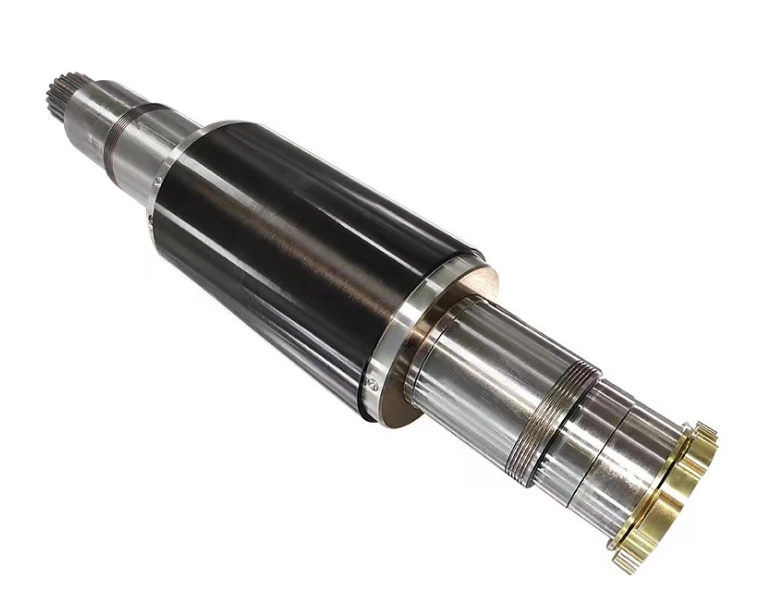
Inside the engine of an Airbus A350, the rotor spins tens of thousands of times per minute. The gap between the carbon fiber sleeve and the metal shaft is twenty times finer than a human hair, yet it remains absolutely stable under extreme conditions.
The carbon fiber sleeve interference fit process has reduced the weight of traditional metal sheaths by over 60%, while providing even greater protective force.
Modern high-speed permanent magnet motors, utilizing this technology, have achieved stable operation at ultra-high speeds of over 150,000 RPM—more than 1.5 times the rotational speed of a common household vacuum cleaner motor.
01 Process Principle
The fundamental principle of the carbon fiber sleeve interference fit is to establish a tight press-fit between the sleeve and the rotor magnets. The radial pressure generated by this fit keeps the two components integral during high-speed rotation, resisting the centrifugal force pulling on the magnets.
The interference fit—specifically, the dimensional difference where the sleeve's inner diameter is slightly smaller than the rotor's outer diameter—is the soul of this process. Precise design of the interference fit enables the sleeve to provide sufficient preload to counteract the immense centrifugal stress the magnets endure during high-speed rotation.
Theoretically, with an appropriate interference fit, the contact pressure generated between the sleeve and the rotor is directly related to the elastic modulus of the sleeve material, the interference fit value, and the geometric dimensions. This pressure must consistently exceed the centrifugal stress on the permanent magnets to prevent rotor failure at high speeds.
The key to the interference fit lies in its independence from adhesives, relying instead on pure mechanical engagement for fixation. This purely mechanical connection avoids issues like adhesive aging and high-temperature failure, making it particularly suitable for the extreme operating environments of high-speed motors.
02 Advantages of Carbon Fiber
Compared to traditional metal sheaths, carbon fiber composite materials demonstrate multiple advantages in interference fit applications. These advantages translate directly into significant improvements in motor performance.
First is the revolution in weight. The density of carbon fiber composites is only 1/4 to 1/5 that of steel, yet they possess higher specific strength. This characteristic means that while providing equivalent protection, carbon fiber sheaths generate substantially lower additional centrifugal force.
The advantage stemming from differences in conductivity is even more pronounced. Metal sheaths, being good conductors, generate significant eddy current losses in changing magnetic fields. Carbon fiber composites, however, can have their conductivity adjusted as needed to reduce or even eliminate eddy current losses, thereby improving motor efficiency.
Thermal stability is another ace card for carbon fiber. The thermal expansion coefficient of carbon fiber composites can be regulated through ply design to match the thermal expansion characteristics of the metal shaft, reducing stress fluctuations caused by temperature changes.
Furthermore, the excellent fatigue performance of carbon fiber allows it to withstand the cyclic loads of long-term high-speed rotation, avoiding the fatigue crack issues common in metal materials and significantly extending motor service life.
03 Primary Assembly Methods
The carbon fiber sleeve interference fit process can be achieved through several methods, each with its unique technical characteristics and applicable scenarios.
The Cold Sleeving Process is one of the most widely used methods. This process utilizes liquid nitrogen to cool the metal component to -196°C, causing its diameter to shrink by approximately 0.2%-0.3%. The carbon fiber sleeve at room temperature is then easily slipped onto the contracted metal part. As the metal returns to room temperature and expands, a secure interference fit is formed.
The Hot Sleeving Process operates in reverse. It involves heating the carbon fiber sleeve to cause it to expand, then quickly slipping it onto the metal component at room temperature. Upon cooling, a tight fit is formed. This method requires precise control of heating temperature and speed to avoid damaging the carbon fiber material.
The Mold Gel Coat Curing Process represents a more integrated approach. This method involves winding resin-impregnated carbon fiber onto the rotor body, then spraying gel coat onto the inner surface of a mold and heating it to cure. Subsequently, the mold is nested around the rotor's exterior, and heating is applied to cure the carbon fiber, integrating it with the gel coat as one piece.
04 Comparison of Process Details
Different interference fit methods have distinct characteristics and are suitable for various application scenarios. The table below compares the technical features of mainstream processes across multiple dimensions:
Process Method | Working Principle | Temperature Effect | Suitable Rotor Size | Advantages | Limitations |
Cold Sleeving Process | Low-temperature metal shrinkage | -196°C low-temperature environment | Medium-sized rotors | Simple assembly, no thermal damage to carbon fiber | Requires liquid nitrogen equipment, higher cost |
Hot Sleeving Process | High-temperature sleeve expansion | 200-300°C high temperature | Small rotors | No special cooling equipment needed | High temperature may damage carbon fiber matrix |
Mold Gel Coat Curing Process | Gel coat forms transition layer | Medium-temperature curing (100-150°C) | Various sizes | No polishing needed, good surface quality | Complex process, long production cycle |
Studies show that the cold sleeving process does not negatively affect the performance of the shaft material, the magnets, or the strength of the magnet bonding adhesive during assembly. Therefore, it is widely used in fields with extremely high reliability requirements, such as aerospace.
05 Key Technical Considerations
Several key technical parameters require precise control and consideration in the carbon fiber sleeve interference fit process. These parameters directly impact the performance and reliability of the final product.
Interference Fit Design is one of the core technologies. Insufficient interference fit leads to inadequate preload, unable to resist centrifugal force at high speeds. Conversely, excessive interference fit may create overly high residual stress within the sleeve, reducing its fatigue life. Typically, the interference fit is designed within the range of 0.1% to 0.3%.
Surface Quality is crucial for the stability of the interference fit. The roughness of the carbon fiber sleeve's inner surface and the rotor's outer surface must be strictly controlled to ensure sufficient contact area and uniform pressure distribution. Research indicates that a 50% reduction in surface roughness can increase contact stress by approximately 30%.
Assembly Speed is another often overlooked but critical parameter. Especially in the cold sleeving process, assembly must be completed within an extremely short time after the metal part is removed from the liquid nitrogen to prevent temperature recovery from causing fit failure.
Environmental Temperature and Humidity Control also significantly impact the performance of carbon fiber materials. Carbon fiber is hygroscopic; moisture affects its mechanical properties and dimensional stability. Therefore, environmental humidity must be controlled during assembly and storage.
06 Applications and Challenges
Carbon fiber sleeve interference fit technology has been successfully applied in several high-end fields while also facing certain technical challenges.
The aerospace sector was one of the earliest application areas for this technology. High-speed motors in aircraft engines and onboard equipment demand extremely high reliability and power density. Carbon fiber sleeve interference fit technology can meet these stringent requirements.
In the new energy vehicle field, as motor speeds continue to increase, carbon fiber sleeve technology is beginning to penetrate from high-end models to mainstream vehicles. Brands like Tesla and Chevrolet have adopted this technology in some models, significantly enhancing motor power density and efficiency.
Medical equipment is another important application area. High-speed motors in devices like CT scanners and dental drills require extreme precision and stability, which carbon fiber sleeve interference fit technology can provide.
However, this technology also faces challenges. Cost is one of the biggest limiting factors. High-quality carbon fiber materials and precision machining processes lead to relatively high overall costs. Additionally, the anisotropic nature of carbon fiber materials makes design and analysis more complex than with traditional metals, requiring specialized simulation and testing methods.
When a vacuum cleaner motor reaches 120,000 RPM, the centrifugal force on the permanent magnet surface is enough to tear apart most materials. Yet, a carbon fiber sleeve thinner than a hair can securely lock the magnet onto the shaft.
Carbon fiber sleeve interference fit technology has already increased automotive motor speeds from 10,000 RPM to over 20,000 RPM, boosting the driving range of electric vehicles by 5-8%. As costs gradually decrease, this technology once exclusive to the aerospace sector is quietly entering our daily lives.


